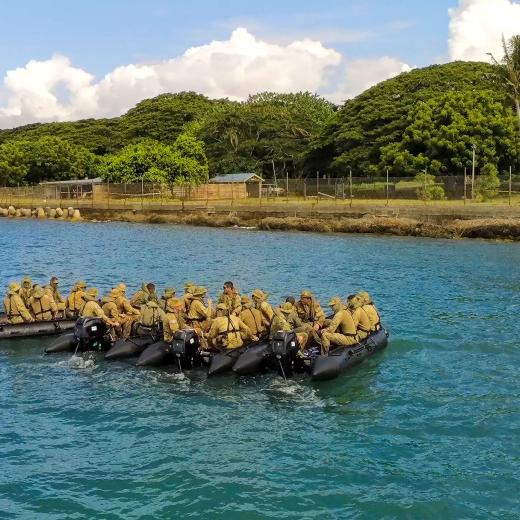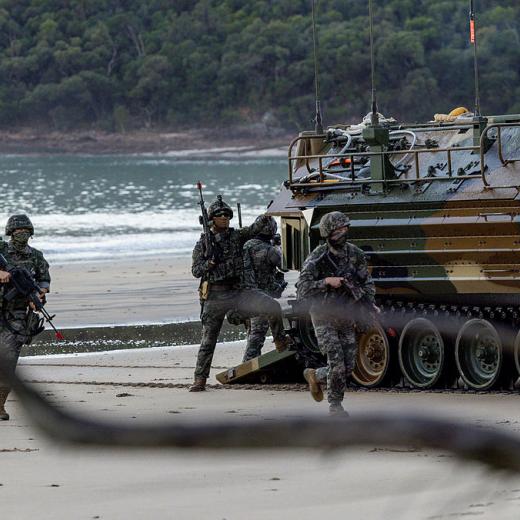
US Marine Corps stands up 3 new combat logistics companies in Japan
BLUF
The US Marine Corps activated new logistics companies under Force Design 2030 to enhance agile support across Indo-Pacific island chains, emphasizing adaptability, modernization, and rapid response to evolving threats and contested environments.Learning Outcomes
- Explain the purpose of the Marine Corps’ Force Design 2030 initiative and its recalibration toward agile logistics in the Indo-Pacific region.
- Analyse the Role of Combat Logistics Battalion 4 in Operational Adaptability.
- Assess how evolving threats such as drones, precision fires, and cyber warfare influence decisions regarding force structure.
References
Related articles
The Australian Defence Force is operating in a time of rapid technological change, intensifying strategic competition, workforce pressure and the need to function as a truly integrated force. In this environment, leadership is our edge and the heartbeat of that leadership is our Non‑Commissioned Officers (NCOs) and Warrant Officers (WOs).
Why Now
NCOs and WOs turn strategy into action. They hold standards, develop people and lead teams in complex, high‑tempo conditions. Our Services already deliver strong leadership development; however, differences in approach and limited integrated exposure at the NCO level can blunt our ability to act as one ADF.
If we expect our teams to deliver integrated effects at speed, we must build integrated literacy, trust and mission command early, reinforcing it at every leadership tier. An ADF NCO Academy would do exactly that: a consistent foundation across Navy, Army and Air Force, while protecting Service‑unique strengths.
The Case for an Academy
Professionalise and Standardise. An integrated academy would align leadership doctrine, ethics, and warfighting principles across the Services. It would set common expectations, build shared understanding and help leaders move across domains without losing credibility.
Strengthen Integration. Integrated operations are our daily reality. We need NCOs fluent in integrated concepts, able to coordinate effects and confident working across Services, agencies and partners, down to team level.
Elevate Mission Command. Disciplined initiative thrives when leaders understand intent, accept responsibility and act ethically. The academy would make mission command a lived practice, growing judgment, critical thinking and accountability.
Improve Retention and Readiness. Clear pathways, modern teaching and recognised credentials show real investment in people. When NCOs know their profession is respected and developed, they stay, grow and lead better.
Anchor Culture and Values. In contested information spaces and domestic support alike, ethical decision‑making and emotional intelligence are mission‑critical. Shared leadership education reinforces trust, respect and lawful conduct across the force.
What It Looks Like
A Tri‑Service Academy with an Integrated Core
A unified integrated core would cover ADF values and ethics, mission command, integrated operations literacy, communication and influence, training design, safety leadership, wellbeing, diversity and inclusion and digital skills (OPSEC, cyber hygiene, information management).
Service‑specific modules sit alongside the core to keep capability‑unique content strong and relevant.
Training Format — Physical, Virtual, or Both?
Use a blended model:
- Residential intensives for the things that matter most in person - coaching, team building, practical leadership tasks and trust.
- Virtual/e‑learning for pre‑work, knowledge modules, reflection activities and reinforcement, reducing time away from units and supporting scale.
E‑learning is viable and essential. It standardises learning, supports throughput and keeps people on the tools while still progressing.
Start Where It Delivers Most: SGT and WO2‑Equivalent
Begin with SGT and WO2‑equivalent cohorts. This is where responsibility for people, supervision, training and culture is most concentrated and where we’ll see the fastest impact. The CDF NCO Leadership Forum repeatedly shows a strong appetite from NCOs to learn together across domains; starting at SGT and WO2 meets that demand head‑on.
Over time, pathways can extend both down (CPL‑equivalent) and up (WO1/Tiered WO equivalents).
Curriculum Coordination Across All Domains
Leadership outcomes must be coordinated centrally and co‑designed with Navy, Army, Air Force and enterprise education authorities to ensure:
- Common language and standards across the ADF.
- Outcomes that match integrated warfighting needs.
-
Protected Service‑specific modules so unique capability isn’t diluted.
Training Time — Add or Reallocate?
Reallocate rather than add. Shift overlapping leadership content from single‑Service PME into the academy’s integrated core to avoid duplication. Services keep their technical mastery time; the academy delivers the common leadership foundation. Net effect: modernised PME without lengthening overall time.
Tiered Pathways Aligned to Responsibility
- Foundation (CPL‑equivalent): First‑line supervision, coaching, safety, integrated basics.
- Intermediate (SGT‑equivalent): Team leadership, training design, ethical leadership, digital literacy, integrated teaming.
- Senior (WO2/WO‑equivalent): Unit leadership, change management, integration planning, organisational culture.
-
Executive Enlisted (Tiered WO equivalent): Strategic advisership, policy, enterprise leadership, international partnerships.
Blended Delivery, Real Credentials
Exportable courses, residential intensives and online modules enable throughput without fighting tempo. Where appropriate, align to AQF credentials (e.g., Leadership & Management; Training & Assessment; Ethics & Governance) to recognise learning and experience, lifting credibility and supporting post‑service transition.
Serious Assessment, Real Performance
Use scenario‑based evaluations, coaching portfolios, authentic tasks and 360s to assess what matters: judgment, influence, standards and results.
Integrated Governance, Clear Accountability
Chaired by the Commandant, Australian Defence College, the academy board includes the SEAC, Service Warrant Officers, RSM-A, Defence education authorities and operational commanders. An academic quality committee safeguards standards and continuous improvement.
Listen, Learn, Adjust — Use the CDF NCO Leadership Forum
The CDF NCO Leadership Forum provides a ready‑made feedback loop. Attendees have consistently asked for more chances to learn together, regardless of domain. The forum can test curriculum relevance, identify gaps and keep the academy grounded in lived experience.
Learning from Our Allies
United States
- US Army Noncommissioned Officer Leadership Center of Excellence (NCOLCoE): Oversees the NCO Professional Development System from entry level to the Sergeants Major Academy, with strong emphasis on leadership, ethics, integrated operations and mission command.
- US Air Force Enlisted Professional Military Education (EPME): Blended and residential programs at scale, leadership, communication and integrated awareness.
United Kingdom
- Defence College of People and Training (DCPT): Coordinates enlisted education across Services, aligning leadership with rank progression and embedding interoperability and ethical leadership; uses international exchanges to broaden perspective.
Canada
- Non‑Commissioned Member Professional Development (NCM PD): Tiered programs (Primary, Intermediate, Advanced) integrating integrated operations, ethics and leadership theory with blended delivery and civilian credentialing.
New Zealand
- NZDF Leadership Development Framework: Structured enlisted pathways emphasising integrated operations, cultural awareness and mission command using residential courses and online modules.
Key Lessons for the ADF
- Tiered, rank‑aligned pathways match growing responsibility.
- Integrated modules build trust and shared understanding.
- Credentials and partnerships boost retention and credibility.
- Blended delivery supports tempo and scale.
- Exchanges improve coalition performance and broaden perspectives.
Addressing the Concerns
“Isn’t this duplication?”
No. The academy delivers the integrated core and leadership fundamentals. Service schools keep capability‑specific and technical mastery. Clear boundaries avoid duplication.
“Do we have the instructor capacity?”
We will build it, phased scale‑up, train‑the‑trainer pipelines, secondments, visiting instructors, Reserve augmentation and partnerships with allied academies. Instructor talent is a strategic asset; we must grow and value it.
“Will tempo and throughput suffer?”
Not if we design it right. Blended models, modular scheduling, recognition of prior learning and virtual content reduce time away, while raising standards.
“Is an integrated model realistic across three Services and five domains?”
Yes, if curriculum is coordinated from the start and co‑owned by the Services. Central governance with Service‑protected modules is both realistic and proven.
“Is e‑learning actually viable?”
Yes, and essential. Use it for pre‑work, knowledge transfer and reinforcement. Keep high‑value residential time for coaching, team tasks, and assessments that build trust and judgement.
“How do we keep it relevant?”
Use continuous feedback. The CDF NCO Leadership Forum provides direct, lived‑experience feedback from across the ADF and participants consistently ask for more opportunities to learn together across domains.
A Measured Path Forward
- Phase 1 (0–12 months): Design, governance, pilot cohorts (start with SGT and WO2‑equivalent), build e‑learning, capture lessons.
- Phase 2 (12–24 months): Scale integrated core; embed Service tracks; start credential issuance; align with promotion/proficiency policy.
- Phase 3 (24–36 months): Full operating capability; international exchanges; continuous improvement; external accreditation.
Measures of success: better supervision quality, retention of high‑potential NCOs, fewer safety incidents linked to supervision, stronger cross‑Service collaboration, positive command‑climate trends, reflected in readiness and integrated effectiveness.
The Leadership We Need
This academy isn’t about bureaucracy, it’s about leaders. Professionally educated, ethically anchored and operationally credible. Leaders who carry commander’s intent across domains; who coach, correct and inspire; who make sound decisions when guidance is thin and the stakes are high.
Most of all, it’s about trust, that when we place an NCO in front of a team, we’ve placed a leader who understands the mission, the people and the consequences and who can act with judgment and resolve.
Our enlisted leaders have carried the burden of readiness, culture and mentorship for generations. They deserve an academy that matches their responsibility and amplifies their impact.
An NCO Academy for the ADF—it’s time.
Biography
WOFF (SEAC) Ken Robertson, OAM, is the inaugural ADF Senior Enlisted Advisor to the Chief of the Defence Force. He is the first Warrant Officer in the history of the ADF to have served as the Senior Enlisted Leader and Advisor to every level of command from O‑4 to O‑10, including two Chiefs of Defence Force. He has held a range of operational and training Senior Enlisted Leader positions and completed multiple overseas deployments to Afghanistan and the Middle East region.
“The strength of any military lies not only in its weapons but in the character of its leaders—and that begins with the NCO.”
General Omar Bradley